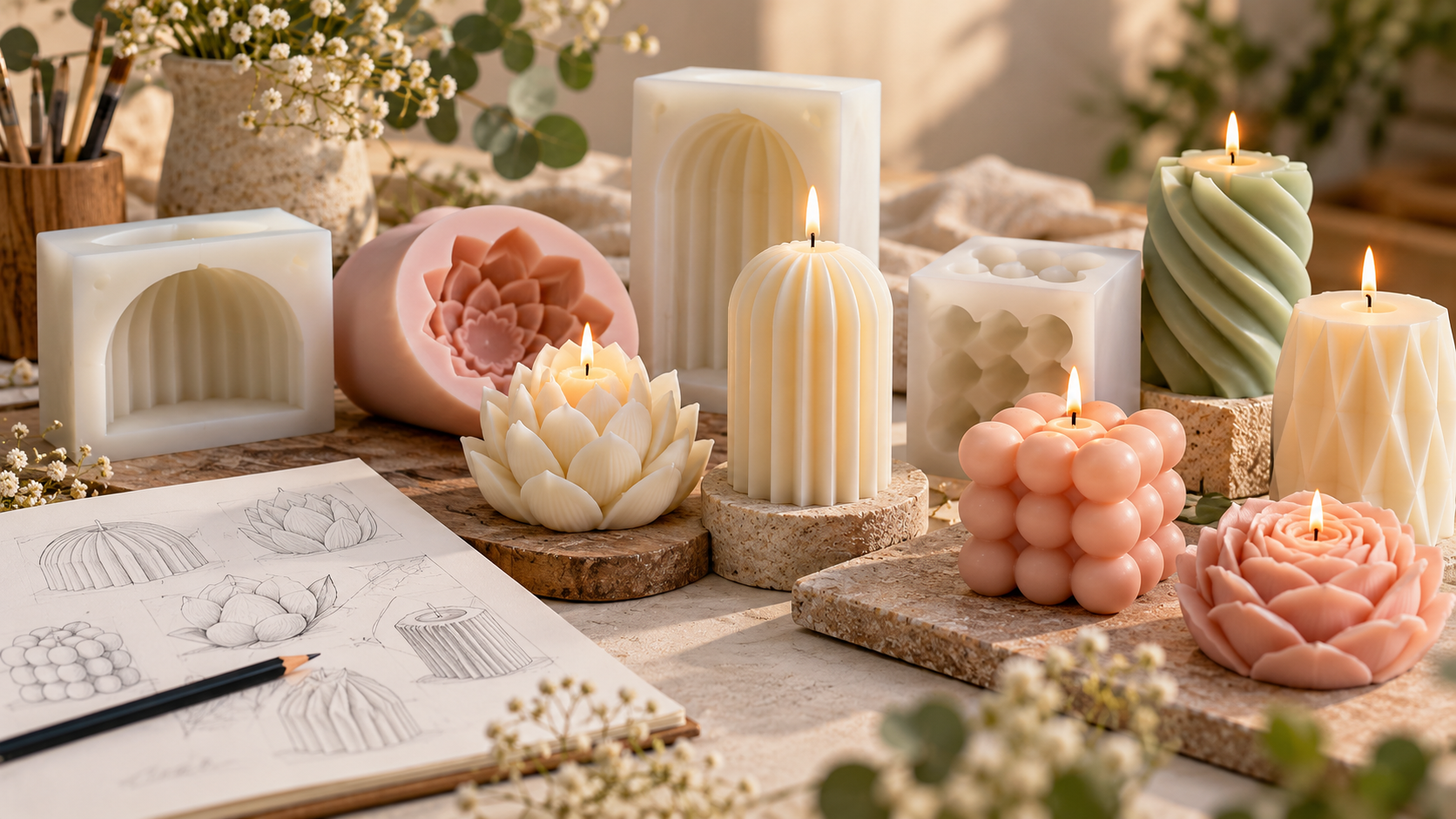
3D Printing in India: How Your Idea Becomes a Custom Mould
How Your Idea Becomes a Custom Mould
##** Imagine having a product idea that doesn't exist anywhere in the market.**
Maybe it's a uniquely shaped candle, a handmade soap with your brand logo, a decorative resin object, or a custom concrete planter.
You can picture the finished product. You might even have a sketch or reference photograph.
But how do you turn that idea into something you can actually manufacture?
That's where 3D printing and custom mould making come together.
For small businesses, independent creators, and handmade product brands in India, 3D printing opens up possibilities for experimenting with new designs without immediately investing in traditional manufacturing tools.
And when combined with silicone mould making, a single prototype can become the starting point for repeated production.
Let's explore how it works.
What Is 3D Printing, and Why Does It Matter?
3D printing, also known as additive manufacturing, is a process of creating physical objects from digital three-dimensional designs.
Instead of cutting material away from a solid block, many 3D printing technologies build an object layer by layer.
This makes 3D printing particularly useful for creating prototypes, testing ideas, and producing complex shapes.
Consider a small business planning to launch a new candle collection.
Traditionally, developing a unique product could require expensive tooling or specialised manufacturing arrangements.
With 3D printing, the business can first create a physical model, examine its shape, and make changes before committing to a production mould.
The real opportunity is not simply printing objects.
It's making product development more accessible to businesses of different sizes.
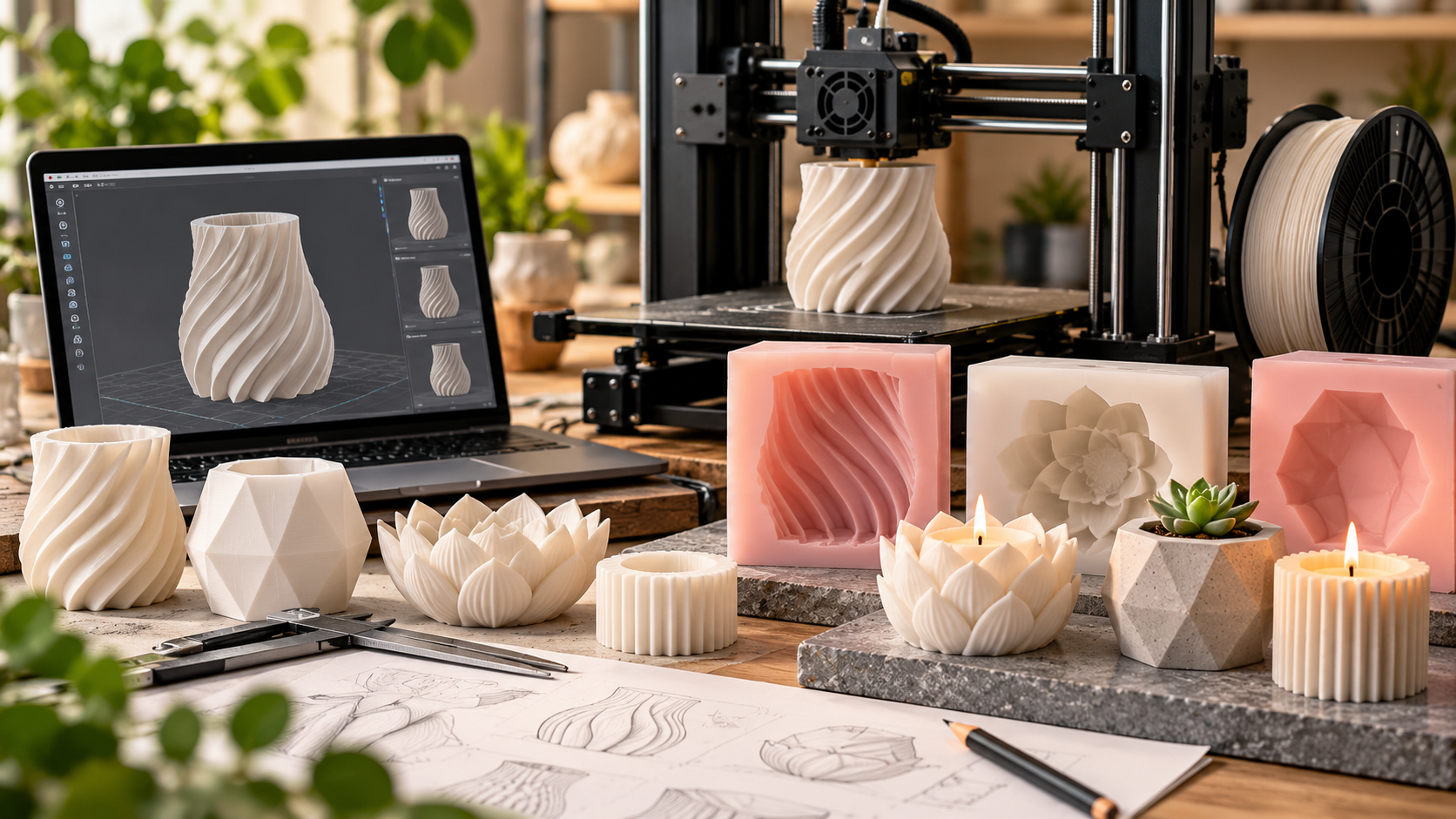
From a Sketch to a Finished Product: How the Process Works
Let's imagine you're launching a handmade candle brand and want an exclusive floral candle design.
Here's how your idea can move from concept to finished product.
Step 1: Start with Your Idea
You don't necessarily need a professional 3D design file to begin.
Your starting point could be:
- A hand-drawn sketch
- A photograph of a shape you like
- A rough product concept
- An existing physical object
- A logo or design element
- A 3D model you have already created
For example, suppose you want a rose-shaped candle with your brand's initials embossed on the base.
The first step is deciding how the finished candle should look, including its size, shape, and important details.
Step 2: Create the 3D Model
Next, the concept is developed into a digital 3D model.
This is where creative ideas meet practical manufacturing requirements.
A design that looks beautiful on screen might need changes before it can be used for mould making.
Delicate projections, deep undercuts, thin sections, and intricate details can affect how easily the finished product releases from its mould.
A well-planned model considers both appearance and manufacturability.
Step 3: 3D Print the Prototype
Once the design is prepared, a physical prototype or master model can be produced using 3D printing.
The prototype allows you to evaluate the actual shape before creating a production mould.
You can inspect its dimensions, check the surface details, and decide whether adjustments are needed.
For a handmade product business, this stage can help prevent costly design mistakes.
Step 4: Prepare the Master for Mould Making
The 3D-printed model often needs finishing before silicone mould production.
Depending on the printing process, the surface may contain visible layer lines, support marks, or other imperfections.
These details matter because silicone can reproduce even small surface defects.
Cleaning, sanding, finishing, and checking material compatibility help prepare the master for mould making.
Some printing resins can also interfere with the curing of certain silicone materials, making preparation and compatibility testing important.
Step 5: Create the Custom Silicone Mould
The prepared master is used to create a mould cavity using a suitable silicone system.
Once the silicone cures, the master is removed, leaving behind the negative shape of the original design.
This cavity can then be used to create finished products with compatible casting materials.
Depending on the design, a single-piece or multi-part mould may be needed.
Step 6: Test and Start Creating
Before repeated production, the mould should be tested using the intended casting material.
For example, a candle maker can test whether the chosen wax fills the cavity properly, captures the desired details, and releases cleanly.
Once the design and mould performance are satisfactory, the business can begin producing its collection.
What started as a sketch has now become a reusable production tool.
Where Can 3D Printing and Custom Moulds Be Used?
One of the most exciting things about this process is that it supports multiple creative industries.
1. Candle Making Businesses
Candle makers can use custom moulds developed from 3D-printed masters to create sculptural candles, floral designs, geometric shapes, festival collections, and personalised gifts.
For businesses selling handmade candles, original designs can help establish a recognisable product identity.
2. Handmade Soap Brands
Soap manufacturers can develop moulds featuring custom bar dimensions, decorative patterns, and embossed brand logos.
Multi-cavity mould designs can also make repeated production more organised.
3. Resin Art Businesses
Resin artists can develop distinctive designs for coasters, keepsakes, decorative objects, nameplates, and other cast products.
3D printing makes it possible to prototype shapes before developing reusable silicone casting moulds.
4. Concrete and Home Decor Brands
For makers producing planters, trays, candle holders, and decorative concrete objects, custom moulds can help transform original concepts into physical products.
Mould design is especially important for heavy castings, deep cavities, and complicated shapes.
Do You Need to Own a 3D Printer to Create Custom Products?
Not necessarily.
If your main goal is to start a candle, soap, resin, or home decor business, investing in a 3D printer may not be the first thing you need to do.
Owning and operating a printer involves equipment costs, materials, maintenance, design knowledge, and finishing work.
You may be better served by working with a custom mould manufacturer who can handle the design and prototype development process.
That allows you to focus on product ideas, branding, testing, and finding customers.
At Saancha, we use 3D printing as part of our custom mould development workflow, helping creators turn their designs into physical moulds.
Can You Use a 3D-Printed Mould Directly?
In some situations, yes.
A rigid 3D-printed mould can be useful for testing particular shapes and applications.
However, a directly printed mould and a silicone mould made from a 3D-printed master are not the same thing.
Rigid printed moulds may be difficult to use with delicate shapes or deep undercuts. Their suitability also depends on the printing material, casting temperature, and surface finish.
Flexible silicone moulds are often more practical for repeatedly producing intricate decorative castings.
The right option depends on what you're making, how detailed it is, and how many units you intend to produce.
How Much Does 3D Printing and Custom Mould Making Cost in India?
There is no single price that applies to every custom project.
The total cost depends on several factors:
Design complexity: Detailed designs may require more modelling, preparation, and finishing.
Product dimensions: Larger models and moulds generally consume more material.
Printing requirements: Printing technology, material selection, resolution, and finishing affect production costs.
Mould material: Silicone type, hardness, and the intended casting application influence the mould specification.
Quantity: A one-off prototype and a production order have different cost considerations.
Testing: Complex projects may require prototype revisions or trial castings.
A useful approach is to begin with a clear design and a small test quantity before committing to a larger investment.
3D Printing for Small Businesses: Start Small, Test, Then Grow
One of the biggest challenges for a new product business is uncertainty.
Will customers like the shape?
Will the product be easy to manufacture?
Will people actually buy it?
Instead of developing an entire collection immediately, consider testing one distinctive product.
For example, a candle entrepreneur could start with a single custom sculptural design, create a prototype, commission a suitable silicone mould, and produce a limited batch.
Customer feedback can help determine whether to refine the design, develop additional variations, or expand production.
This approach does not eliminate business risk, but it can help reduce the amount invested before the concept has been tested.
And importantly, you don't need a large factory to start exploring your own designs.
Frequently Asked Questions
Can I make silicone moulds using 3D printing?
Yes. A common approach is to create a 3D-printed master model and then cast a silicone mould around it. The finished silicone mould is separate from the printed master.
Can a custom mould be made from a photograph?
Many custom mould projects can begin with reference photographs or sketches. Additional dimensions and design information may be needed to create a suitable 3D model.
Is 3D printing suitable for candle mould making?
Yes, 3D printing is useful for creating candle prototypes and master models. The final mould material must be chosen according to the wax formulation, pouring temperature, and design requirements.
Can I create a mould with my business logo?
Yes. Logos and brand details can be incorporated into mould designs when their size, geometry, and placement make them practical to reproduce.
Do I need to order moulds in bulk?
Not necessarily. Some manufacturers, including Saancha, accept single custom mould orders, allowing businesses to test their ideas before purchasing larger quantities.
How long does custom mould development take?
The timeline depends on design complexity, revisions, printing, finishing, mould production, and testing. Share your requirements to receive an estimated turnaround time.
Turn Your 3D Printing Idea into a Real Product with Saancha
A creative idea deserves more than staying inside a sketchbook or on a computer screen.
Whether you're building a candle business, launching a handmade soap collection, experimenting with resin art, or developing a custom home decor product, 3D printing can be the first step toward bringing that idea to life.
At Saancha, we combine 3D design, prototype development, and custom mould manufacturing to help creators develop products around their own ideas.
From a single prototype to a reusable silicone mould, our goal is to make the process practical and accessible.
Have an idea, sketch, photograph, or 3D model?
Share it with Saancha and let's explore how it can become a custom mould.
Explore Custom Moulds: https://www.saancha.in/custom-moulds
Browse Ready-Made Moulds: https://www.saancha.in/shop
Saancha — Turning concepts into reality.